Compromise is our business: responses to theatre, art, and politics

REVIEWS, RESPONSES, REFLECTIONS, RESEARCH, RANTS AND RAVINGS

Tuesday, 12 October 2010

Labours of love: Whittaker and Caesar's Starfuckers


Following in the tradition of famous artist couples such as Marina Abramovic and Ulay, performance maker Malcolm Whittaker and his partner Laura Caesar, billed as a “primary school teacher and arts and crafts enthusiast,” developed and performed the durational performance Starfuckers. Whittaker and Caesar’s suburban narrative landscapes offer a significantly more intimate if lower-key performance to Abramovic and Ulay’s break-up event, Great Wall Walk (1989).

One at a time, our partners in love and art step up to a microphone and read out a story. Some are diary entries written during the making of the project, and some are personal relationship memories. Each of these stories has been printed out and inserted into a magazine—Woman’s Weekly, Who, New Idea—torn out after they have been read and put immediately through a shredder. At the other end of the room, the detritus of these pedestrian love stories with their glossy celebrity underlay is transformed into papier-mache, moulded into figurines and baked in a small oven. Wearing aprons, the performers take turns to read, share and deliver the shreddings to be glue-soaked and flour-covered, shaped, baked and finally displayed in an ever-multiplying tableau across a long red-covered table. The small studio seems overly warm, filled with the crisp smell of baking paper, and over the hours a small army of tiny figures—effigies of the performers themselves?—gradually populates the long central table, filling up the space previously occupied by language alone.

Read the rest of my article, Labours of Love, published in the sprint and online editions of RealTime #99, here.

Wednesday, 6 October 2010


I'm trawling through my old notebooks, looking for my descriptions of my first meeting with Paul Dwyer to talk about what became The Bougainville Photoplay Project. What I hope to find is something of the pre-history of the work to use in a note I'm writing for the published performance text that will shortly be released through Currency Press. Whilst I've found lots of rehearsal notes from the last five years of casual, now-intense, now-languid, workings that somehow conspired to create the beauty of that work, the precise target of my search - the very first extended discussion in Ralph's Cafe at the University of Sydney early in 2005 - is proving elusive.

What I am finding, perhaps unsurprisingly, are huge amounts of memories, tiny moments peppered with my exhortations to remember particular things, things which, in the act of writing them down, I promptly forgot. I remember two comments along these lines - "writing is a technology of memory" (Edward Scheer, though he was probably quoting someone else), and "we write in order to forget" (Paul Dwyer, I think, whilst we were making CMI back in 2003).

Anyway, given the context of my searches down memory lane (if nothing else, The Bougainville Photoplay Project is a performance about remembering - I found the following citation of deep interest:

"The antithesis of the theatre of indifference is not spontaneous simplicity, but drama in which both the principle protagonists and the audience have a common interest. The historical precondition for the theatre of indifference is that everyone is consciously and helplessly dependent in most areas of their life on the opinions and decisions of others. To put it symbolically: the theatre is built on the ruins of the forum. Its precondition is the failure of democracy. The indifference is the result of the inevitable divergence of personal fantasies when isolated from any effective social action. The indifference is born of the equation between excessive mobility of private fantasy and social political stasis. In the theatre of indifference, appearances hide failure, words hide facts, and symbols hide what they refer to."

John Berger, 'The Theatre of Indifference' in The Sense of Sight (1975: 72-73)

Whilst I remain far from Berger's apparent pessimism expressed here about the political possibilities of the theatre, in my current reflection of The Bougainville Photoplay Project I've become very interested in what he might mean by the "common interest" of the protagonists and the audience. This is obviously not a post in which I'll engage in deep thinking, but at the shallow end of the analytical pool: might such a "common interest" be found in shared national histories, whether these histories might be remembered, forgotten or actively concealed? Might a "common interest" be found in the shared status of the performer(s) and audience as 'citizens', especially when the theatrical experience attempts, in a small way, to unpack some of the actively-forgotten backstory of this civic enterprise? Surely moments like these are where theatre not merely covers over the "ruins of the forum", but rather actively aims to build a civic dialogue?

At any rate, I've now hit the wall in the shallow end of the analytical pool, and should go back to the notebook trawl. See you all in the theatre soon so we can all begin remembering together.

Saturday, 13 February 2010

Beauty disturbed: Ruhe, Sydney Festival


Upon entering Sydney University’s Great Hall, I am faced with a multitude of tightly packed mismatched chairs filling the space. Watched by portraits of past Chancellors, I negotiate my way amongst other audience members to find a place to sit. As the last stragglers are seated, an ordinary-looking man in front of me stands on his chair, joined by another eight men. These men of the renowned choir Collegium Vocale Gent sing, in glorious a cappella harmony, a selection of songs by Franz Schubert. The title of the performance comes from their third song, Ruhe, schoenstes Gluck der Erde (Rest/calm/silence, earth's sweetest joy).

Read the rest my response to Ruhe, published in the print and online editions of Realtime #95, here.

Thursday, 21 January 2010

Urban navigation

In the midst of an interesting, but yet-to-become-exciting Sydney Festival, I've happened in the last week to read two gorgeous blog postings about civic navigation.

In a post entitled 'The things nobody tells you about Berlin', intrepid guerrilla semiotician and international-woman-of-mystery Jana Perkovic reflects elegantly about the "combination of relaxed slowness and elephantine change, of poverty and big projects" of Berlin, a combination which "means that everything that is imaginable may be possible. Not always in the perfect way [...], the cleanest and neatest, but it may be there, just inside a courtyard or underground or some distant U-Bahn stops away. Berlin is a New World, right in the centre of the Old." Read more here. Given that it was only last Friday that I lodged my funding application for support to attend a major theatre networking event in Berlin in April, I read her post with much enthusiasm.

Also navigating Berlin, amongst a wide range of other cities, is Geoff Manaugh's post 'Nakatomi Space'. A dizzying reflection on urban navigation through the violent re-organisation of architectural features in both cinema and the real-world, Manaugh somehow manages to build a theoretical narrative arc from the first Die Hard film, to recent Israeli military tactics, to the contrasting modes of urban navigation in recent Bond and Bourne films. In the post, he cites a commander of an Israeli paratrooper brigade stating: "There is no other way of moving! If until now you were used to moving along roads and sidewalks, forget it! From now on we all walk through walls!"

It's frightening and deeply impressive. Inspired, I've re-watched all three of the Bourne movies this week. In the second and third movies, Berlin didn't quite look as Perkovic has described it, but I guess I have to navigate this space for myself, just to be on the safe side. I will, however, almost certainly stick to the streets, rather than making new paths for myself over rooftops or through walls.

Wednesday, 13 January 2010

New year, new blog

Dear fellow cyberspace dwellers,

Welcome to a brand new year. And unlike that troublesome 2009, I'm confident that this will be a great one.

For those of you who follow this blog for version 1.0 news, I've decided to set up another blog dedicated solely to version 1.0 projects, and that can be found here: http://versiononepointzero.wordpress.com/ Over the next few months, I'll be archiving a range of writings about version 1.0 projects, from program notes, to unpublished academic writings, to research materials on that site. For convenience, this blog can be accessed directly from the newly-updated version 1.0 site.

It's going to be a huge year for us, and one in which our artists and our works get out around the country, as well as the occasional overseas jaunt. First up though, we're taking our alcohol-fuelled, techno-beat driven meditation on sexual violence in contemporary culture to the Adelaide Fringe Festival. It'll be the first ever show we've taken to Adelaide, and given the number of past and current company artists who hail from that city, it seems an amazing omission. Check it out - 6 shows only at the Norwood Concert Hall from February 20-26.

Hopefully I'll have some time in the next month to open up some of my notebooks and reflect a bit on the year that was 2009 in performance. Despite being away on tour for 3 months, I managed to see some deeply fascinating, and some deeply ordinary, performance works, few of which I've managed to respond to here. With luck, this will not be replicated in 2010.

More soon.

Tuesday, 15 December 2009

Innocents retrieved: UTP's The Fence for Sydney Festival

The Fence, Urban Theatre Projects’ new performance for the 2010 Sydney Festival, promises “an explosive tale of love, belonging and dispossession.” Taking place in an undisclosed backyard in Parramatta, the performance investigates the “resilience and wisdom of five middle-aged Australians, four of whom were removed from their homes and grew up in care as part of the stolen generations and the forgotten Australians.”


Read the rest of my article 'Innocents retrieved', published in the print and online editions of RealTime #94, here. Image by Heidrun Lohr.

Friday, 27 November 2009

The pleasures of patriarchy: version 1.0’s THIS KIND OF RUCKUS

This is a piece that I started a couple of months ago in response to some thoughts expressed in our artist talk for THIS KIND OF RUCKUS. Like much of my current writing, it's been languishing as I grapple with the endless paperwork that running a so-called 'Key Organisation' entails. Given the current swirling discontent around gender equity in writing and directing theatre in Sydney (not formal issues which directly apply to version 1.0 given the nature of our group devising practice), I thought that it was probably time to throw this out there, unfinished and inelegant as it is.


In our exploration of depressingly ordinary, run-of-the-mill sexual violence – violence in the form of struggles for power and control that occur within all intimate relationships – we were forced to recognise and confront the reality of male power. Not only did we reflect at length on the banally obvious fact of physical difference – “He feels tall. Towering tall”, as Kym notes in our couples mediation session midway through the show. There’s a physical capacity for violence built into the male body and, like it or not, this remains close to the surface. Not that this is intended in any way to excuse the behaviours of violent men. On the contrary, such men far too easily get such behaviours excused on the basis that these were an aberration, a one-off, pushed over the edge, under the influence, under pressure, under attack, and will never ever happen again. Until the next time, which will also undoubtedly make claim to being another once-off. No, the point is more that all male bodies are capable of such violence, and as such must remain self-aware to keep such capacity in check.


Now, I like to think that I’m a sensitive, caring, considerate kind of guy, a so-called SNAG (presuming that the reader will permit me the excision of some of the more hippy connotations of ‘new-age’). I like to think that I have a healthy belief in both gender equity and personal excellence, and as such, that I oppose discrimination without reducing solutions to such discrimination to mere quotas. I like to think that ‘reverse discrimination’ initiatives should remain temporary measures. Most of my bosses in a wide range of jobs have been women, and its fair to say that almost all of my significant mentors have been female artists and artsworkers. I like to think that I’ve absorbed many of the primary lessons of feminism – biology is not destiny, the personal is political, etc, etc.


I begin with this awkwardly affirmative-action paragraph in order to indicate the scale of my self-deception. As we were making THIS KIND OF RUCKUS, the closer attention we paid to gender politics and power struggles within relationships, the more I realised that despite my belief to the contrary, I benefit from patriarchy. Not only that, but I use these benefits for my own advancement. Subtly, of course. And most importantly, I like it. I enjoy these benefits. This pleasure in (relative) power is unavoidable, even though it becomes, upon reflection, somewhat abhorrent to me. When I think too closely about it, I begin to despise the sight of myself in the mirror. Despite this reflective abhorrence, the simple fact remains that my power as a man is largely invisible to me. And by invisible, I mean that I am not required to think about it very much at all. I can walk through the world and think very little about my power – my power to inflict physical and psychological harm, my power to remain safe from various forms of assault whilst walking on the street, my power to only be required to be afraid of particular kinds of physical harm NONE OF WHICH attack my status as a subject. I have within my power the ability to effortlessly retain the status of a subject, and am never forced to risk reduction to an object. I benefit from patriarchy* and I like it. How could it be otherwise?


If this project was to succeed in anything, it should be to have made visible, however fleetingly, those powers that men wield that remain, in everyday life, invisible to us.


*Of course, it doesn’t hurt that in addition to being male, I’m white, physical unimpaired, and middle-class (in upbringing if not in income – I do work in the arts after all!)


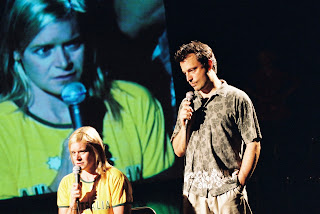
Image: Kym Vercoe and David Williams in version 1.0's THIS KIND OF RUCKUS. Photography by Heidrun Lohr.